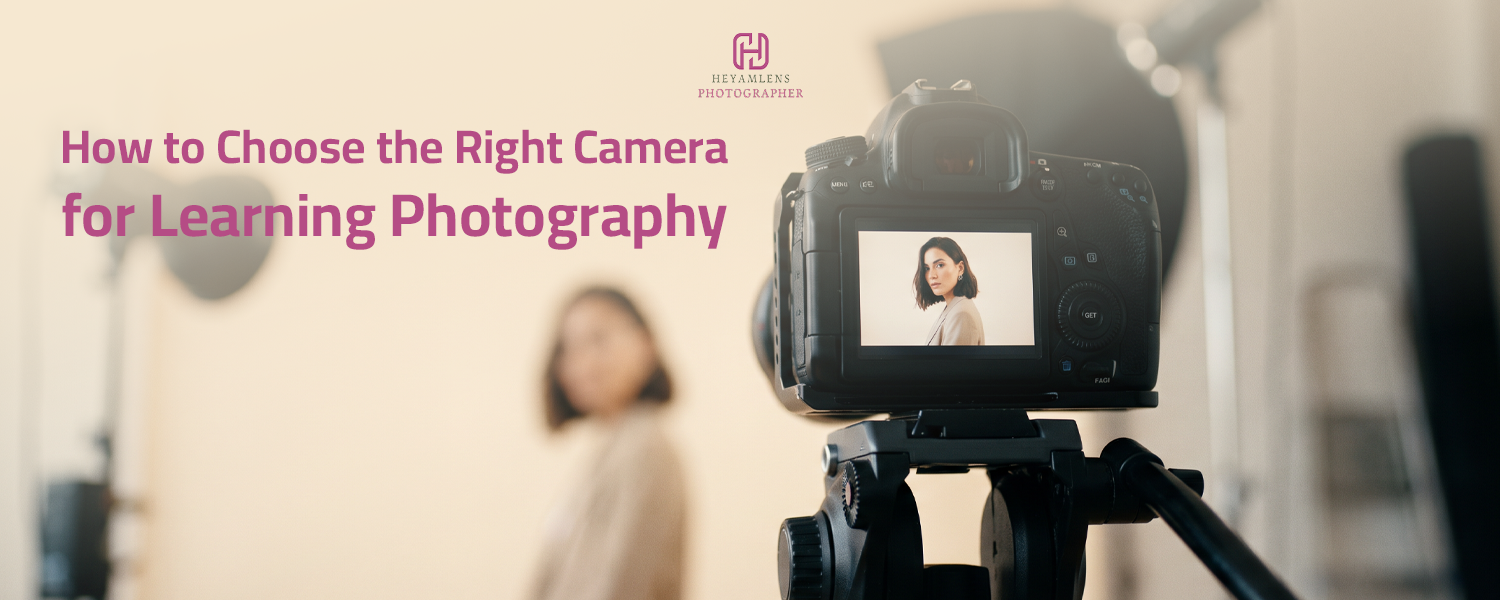
How to Choose the Right Camera for Learning Photography
How to choose the right camera is the first real test facing anyone serious about learning photography, You open an online shop and find dozens of near-identical bodies, spec sheets full of numbers that mean nothing, and a salesperson pointing at the priciest option. Yet the most expensive body is rarely the best fit, and the wrong call here costs you thousands and kills your enthusiasm early. You need clear priorities, not a technical background. In this guide from Heyam Lens, we turn that confusion into criteria you can decide by.
Start With Your Goal Before Asking How to Choose the Right Camera
The best body for one person can be the worst for another, and the real difference comes from the type of work you intend to specialise in:
Portraits and People
Here you need a sensor that renders skin tones naturally, along with a fast lens that separates your subject from the background smoothly.
- Prioritise lens quality over the body itself, because facial detail and colour rendering travel through the glass long before they reach the sensor.
Product and Commercial Content
This path demands high detail accuracy and consistent colour from one frame to the next within the same session.
- Choose a body that supports tethered shooting and full manual control, since it saves you hours of correction and colour matching afterwards.
Travel and Everyday Documentation
Weight and responsiveness matter most here, because the best camera in this field is the one you actually carry rather than leave at home.
- Look for a compact body and a battery that lasts a full day, since excess bulk kills your motivation after the first long trip.
Camera Types and How to Choose the Right Camera Among Them
Every photography camera available today falls into one of three families, and each family follows a different logic in use:
DSLR Bodies
An established category offering longer battery life and a huge supply of second-hand lenses at prices a beginner can reach.
- Ideal for maximum value on a limited budget, though they are heavier and bulkier than the newer alternatives on the market.
Mirrorless Bodies
These rely on an electronic viewfinder that shows the result of your settings before you shoot, which shortens the learning curve noticeably.
- They deliver faster autofocus and stronger video, suiting anyone building visual content that moves between stills and short clips.
Compact Cameras
A light option with a fixed lens, better suited to daily documentation and travel than to paid professional work.
- They offer no lens flexibility, so treat them as a second body or a very simple starting point before moving up a tier.
Five Technical Criteria That Settle How to Choose the Right Camera
Spec sheets are long, but only five items make a real difference to your final image, ranked as follows:
1. Sensor Size
A larger sensor gathers more light, giving you cleaner detail and better background separation, particularly indoors and in weak lighting.
- Compare tiers by sensor area rather than megapixel count, because surface area is what actually determines how clean the image looks.
2. The Available Lens System
Never buy a strong body surrounded by rare or overpriced glass, since lenses are your real long-term investment, not the body.
3. Low-Light Performance
Test the body at high sensitivity settings, because evening noise is what exposes the weakness of cheaper models fastest.
- Ask for a test shot inside the shop under normal lighting, then zoom in on screen and inspect detail in the shadow areas.
4. Autofocus and Stabilisation
Fast autofocus and in-body stabilisation save you lost frames, and both are essential for photographing children, movement and video.
5. Weight and Ease of Use
A heavy body with complicated menus reduces how often you use it, and skill is built through daily repetition before any spec.
- Hold the body with its lens for a few minutes before buying, because weight that feels fine in-store doubles after an hour of shooting.
Budget and Its Role in How to Choose the Right Camera
The financial decision matters as much as the technical one, and your budget can be arranged intelligently along these lines:
- Split your budget roughly in half: one part for the body, one for the lens and accessories, which delivers better results than spending everything on the body.
- Consider the second-hand market from a trusted source seriously, as it puts you a full tier higher for the same price once you inspect the condition properly.
- Calculate essential accessories in advance: a fast memory card, a spare battery, a bag and a tripod, since these are operating costs rather than luxuries.
- Do not drain the entire budget on the first purchase, and keep a portion for learning, because that is what turns a device into actual photographs.
Common Mistakes That Ruin a First Purchase
Beginners tend to fall into the same traps, and these are the most frequent:
- Chasing the latest photography camera on the market drains your budget without moving the quality of your images a single step forward.
- Being dazzled by megapixel counts alone, when light quality and sensor size affect image clarity far more than resolution does.
- Skipping a hands-on test before buying, since grip comfort and button layout decide how much you enjoy shooting over the long run.
- Buying several lenses at once, when one lens you know intimately produces stronger work than five lenses you barely touch.
- Assuming the answer to how to choose the right camera ends at checkout, when the real skill only begins once the device is in your hands.
From How to Choose the Right Camera to Mastering It With Heyam Lens
Owning the gear is one step; turning it into images that sell and get published is another, and two training programmes cover exactly that:
Professional Camera Photography Programme
Book your seat now in the professional camera photography programme if you have just bought your body and have no idea where to start. It walks you through settings, lighting, composition and angles in plain practical terms, moving you from auto mode to full control.

Advanced Camera Photography Programme
Enrol now in the advanced camera photography programme once the basics are behind you and you need a higher level. It puts you in real shooting environments matched to your field, so you finish with a portfolio that opens the door to paid work.
Frequently Asked Questions About How to Choose the Right Camera
Do I need a professional body when I am starting out?
- No, a mid-range body is entirely enough while learning, because skill is built on understanding light and composition long before it depends on expensive specifications.
Is buying second-hand safe for a beginner?
- Yes, provided the condition is good and the shutter count is low, it gives you the full experience for less and leaves budget for lenses.
Which matters more, the body or the lens?
- The lens usually, since it determines sharpness, separation and how much light enters, while differences between bodies can usually be corrected in settings and editing.
Ultimately, how to choose the right camera comes down to your goal, your budget and the way you work, not to a salesperson’s advice or a polished advert. Define your need first, buy only what serves it, and remember that Heyam Lens stays with you from the first decision through to full command of your gear.
Book your consultation or training programme today with Heyam Lens before the schedule fills up, and let practical experience settle how to choose the right camera for you, so you start shooting with confidence from the very first day.